
The Timeline for Holy Trinity Church
845 - 2026
845
Saxon monastery on site with wooden buildings. Beorthwulf, King of Mercia, grants Bishop Heaberht of Worcester privileges to the ‘monks of Ufera Stret Ford on the banks of the Eafene.’

1086
Stratford mentioned in Domesday Book: “in demesne two carucates with twenty-one villains and a priest”. Norman church built in stone over earlier Saxon foundation.

1196
Charter granted by Richard I to the lord of the manor, John de Coutances, Bishop of Worcester, giving the right to hold a weekly market with defined burgage plots for the new town.

1210
Transepts and tower of church constructed as we see them today.

1280 - 1310
Pillars supporting tower strengthened and tower increased in height (or rebuilt). North aisle of nave widened to make space for Lady Chapel. Processional arches closed on west and east sides of north transept, leaving ‘squint’ openings to view high altar in old chancel.

1331
New south aisle of nave built by John de Stratford, former Rector of the church, to accommodate St Thomas Becket chantry chapel. This became a major place of pilgrimage and so funded a college of priests. John de Stratford became Archbishop of Canterbury in 1333 and later Chancellor of England.

1353
College building constructed near the church by Ralph de Stratford, Bishop of London, to house the priests serving the chantry.

1413
Henry V added to endowments of the College, granting the title of Collegiate Church.

1465 - 1490
Construction of new chancel by Thomas Balsall, Dean of the College. Stained glass windows paid for by Hugh Clopton.

1480 - 1485
Construction of north porch. New oak inner doors, incorporating old sanctuary knocker from 1270.


1500 - 1510
Building of clerestory with lantern windows above nave and great west window by Ralph Collingwood, Dean of the College.

1547
Henry VIII died and Edward VI became King. Royal Injunctions required destruction of ‘abused’ images and pictures, prohibition of processions around the church at Mass and recitation of the rosary. The College was disbanded and all College property reverted to the Crown.

1553
Edward VI died. Mary Tudor became Queen. 2,000 married clergy evicted. All religious laws of Edward’s reign repealed and the Latin Mass restored. Widespread execution of Protestants.

1538
Royal Injunctions instructed the clergy to take down images 'abused' by superstitious rites and to preach against pilgrimages. No candles except on rood, high altar and Easter sepulchre. No veneration permitted of images or relics. No more lights burning before the Blessed Virgin Mary in the Lady Chapel.

1558
Mary Tudor died and Elizabeth I became Queen. Set of five bells brought from Hailes Abbey and fitted in tower.

1561 - 1565
Stained glass removed and images defaced at Holy Trinity. Medieval rood screen moved from nave arch to block off chancel. Wall paintings covered by limewash.

1564
Baptism of William Shakespeare on 26th April: “Gulielmus filius Johannes Shakspeare” (William son of John Shakespeare).

1582
William Shakespeare married Anne Hathaway, not in Holy Trinity Church but perhaps at Temple Grafton.

1583
Susannah Shakespeare was born, six months after her parents marriage and baptised on 26th May.

1585
Shakespeare's twins Hamnet and Judith born and baptised in Holy Trinity on 2nd February.

1596
Hamnet Shakespeare dies, aged 11. He is buried somewhere in the churchyard on 11th August.

1605
William Shakespeare purchased a lease of a moiety of church tithes, by which he became ‘Lay Rector’. This made him responsible for the maintenance of the chancel and allowed him to purchase the area for his family graves in front of the high altar.
1611
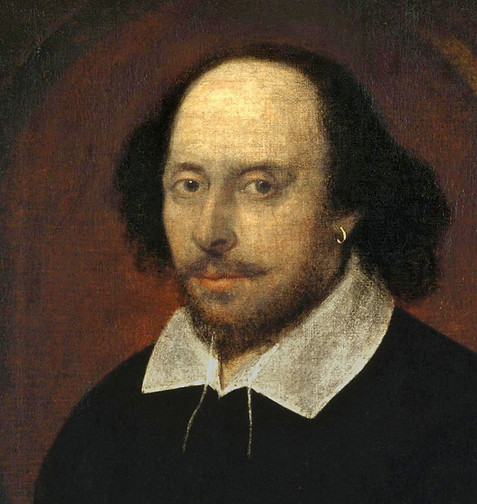
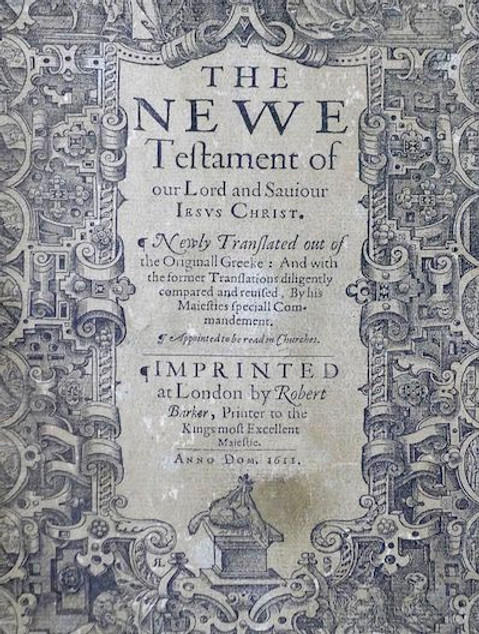
King James Bible published (Holy Trinity receives second printing, 1613). An unproved suggestion is that Shakespeare may have been involved in the translation into English because of the coincidence that in psalm 46 the 46th word from the start is "shake" and the 46th word from the end is "spear".
1616
Judith Shakespeare marries Thomas Quiney on 10th February but without the necessary special licence require for a wedding in Lent. Thomas Quiney was excommunicated.

1635
Dr John Hall, Shakespeare's son-in-law who had married Susannah in 1607, died and was buried in the family plot in the chancel of the church.

1649
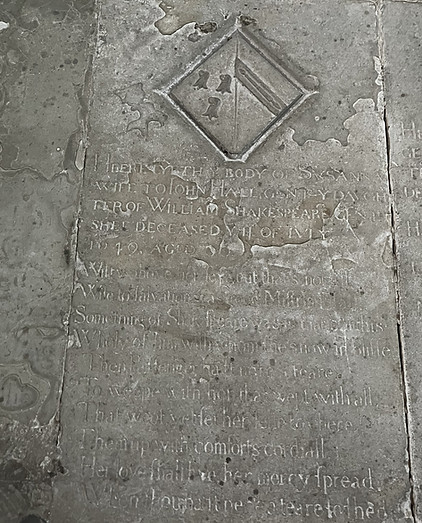
Susannah Hall died aged 66. The original epitaph on her grave (removed in 1707) read:
"Witty above her sex, but that's not all,
Wise to salvation was good Mistress Hall.
Something of Shakespeare was in that, but this
Wholly of him with whom she's now in bliss.
Then, passenger, hast ne'er a tear
To weep with her that wept with all?
That wept, yet set herself to cheer
Them up with comforts cordial.
Her love shall live, her mercy spread,
When thou hast ne'er a tear to shed."
1662
Judith, who had married Thomas Quiney, was not buried with her parents and sister in the chancel but, like her brother, in the churchyard on 9th February 1662 aged 77.

1642-45
English Civil War in progress. Parliament ordered the destruction of all ‘vestments, organs, fonts, lofts and images’. Probably when the ancient font and King James Bible were damaged. Musket ball holes in stonework of porch. Bells taken and melted down for armaments.

1675
Spire added to tower, with lead covering a squat wooden frame.

1695
King James Bible rebound in board covers.

1701
Damaged ancient font removed from south aisle and taken to garden of the Parish Clerk. Replaced by blue marble vase of classical design.

1719
Avenue from gate to north porch paved by donation of Alderman John Hunt.

1720
Brass candelabrum donated by Sarah Woolmer whose family had also donated the church’s communion plate.

1731
New organ built by Thomas Swarebrick over the arch of the tower, later moved to east end of nave.

1635
Joseph Greene, curate of Holy Trinity, began raising funds for ‘repairing and beautifying’ the Shakespeare Monument, which had become ‘much impaired and decayed’. The repairs were carried out by a local craftsman, John Hall, a ‘limner’ or painter.

1649
Old wooden spire replaced by new taller stone spire.

1769
Garrick’s Jubilee in Stratford awakened worldwide interest in Shakespeare. First floral tributes organised by Mrs Garrick, beginning the tradition of floral birthday tributes. Thomas Arne conducted his work “Judith” in the church.

1793
Shakespeare bust, and the figures on either side, painted white by ‘meddling’ Malone.

1799
College building demolished by its owner, Edmund Battersbee, because it spoiled his view of the church.

1800
Charnel house (“bone house”) demolished and door to chancel walled up.

1823
Old broken font, in which Shakespeare had been baptised, returned to the church from garden in the town.

1800
Restoration of the chancel, including removal of plaster ceiling and laying of new floor, new altar rail, and cross mounted on east gable. Ugly brick vestry demolished. Roofline of transepts restored to original pitch. (Funds raised by the Shakespeare Club).

1823
Nave reorganised with new pews, galleries and a font copying the style of the one in which Shakespeare had been baptised.

1850
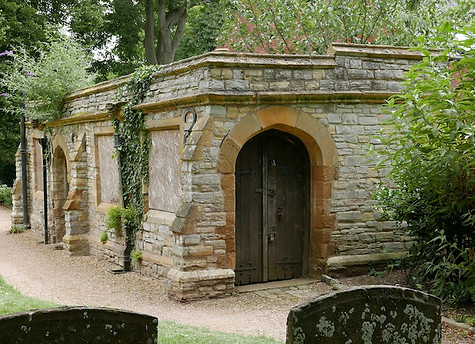
Bier house constructed on south side of churchyard, close to the south door of church, used for coffins en route to funeral services.
1861
Shakespeare monument restored, including removal of the white paint applied by Malone.

1870
Iron clamps and rods fitted to stabilise the masonry of the tower.

1861
Shakespeare monument restored, including removal of the white paint applied by Malone.
1870
Churchyard declared full and closed for further burials (new town cemetery in Evesham Road). Avenue planted with lime trees (12 on each side).

1884
Report by Society for Preserving Ancient Buildings (SPAB) expressed concern about ‘over-restoration’ and made a series of recommendations.

1889
Organ moved from north transept, enlarged, and divided, with the ‘choir, swell and pedal’ ranks at end of south aisle and the ‘great organ’ above the central nave arch.

1890
The ‘Shakespeare Window’ installed on the north side of the chancel, depicting the seven ages of Man, paid by American donations.

1897
American Window in south transept unveiled by the American Ambassador. Shortfall in funding paid by local novelist and conservationist Marie Corelli.

1890-92
High Altar reconstructed with mensa of Purbeck marble from Becket chantry chapel (found in 1889, hidden beneath floor in south aisle). Restoration of misericord stalls and oak wall panelling in chancel.

1903-09
Exterior of north aisle restored. Gas light fittings in the church removed and electric light fittings installed.

1921
Reredos made from teak and copper sheathing of HMS Britannia placed in St Peter’s Chapel as memorial to parishioners who died in the Great War (now in Becket Chapel).

1925
West front found to have no foundations and underpinned with reinforced concrete.

1938-40
Complete restoration of clerestory windows on south side.

1948
All ten bells re-cast and re-hung in tower.

1963
Rood screen (formerly leading to the chancel and through which Shakespeare’s coffin would have passed) moved from middle of north transept to present position in tower arch to screen off choir vestry, Organ rebuilt with a new electro-pneumatic console and electric action transmissions.

2003
Friends of Shakespeare’s Church founded as a charitable trust.

1993
Lime trees along avenue replanted (12 on each side – right side representing the 12 apostles and the left side the 12 tribes of Israel).

2009
Major repair programme, funded by the Friends: (1) chancel roof, which had been damaged by dry rot and death watch beetle; (2) tower and spire, which were in danger of collapse; (3) restoration of clerestory windows on north side.

2010
Refurbishment of St Peter’s Chapel in South Transept and of muniment room above north porch.

2024
Major restoration of the organ undertaken by Nicholsons of Malvern.

2016
Completed extension on south side of church with new clergy vestry and toilets, in time for the 400th anniversary of Shakespeare’s death.

2025
Victorian sedilia restored as part of refurbishment of the Becket Chapel.
